A First Visit to a Shared Workshop: What to Notice at the Door
A first visit to a shared workshop feels easier when you know what to notice: the welcome point, tool storage and instructions that help you begin.
You arrive at a shared workshop carrying a project idea, but the entrance opens onto benches, tool cupboards and people already at work. On a first visit to a shared workshop, the useful question is not whether the room looks impressive; it is whether you can tell where to start, what you may use and whom to ask.
Notice the room as a newcomer would, without treating one confusing detail as proof that the whole place is unwelcoming. Different workshops organise themselves for different tasks. A ceramics studio, repair shed and community woodshop will not need the same arrangement, but each should offer a legible route from the door to a first safe question.
Where should you look first at the door?
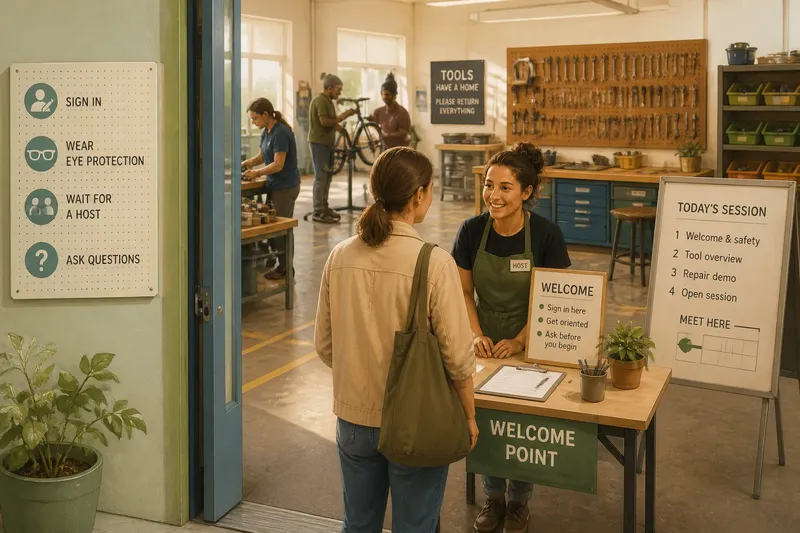
Look for a welcome point that is identifiable before you need help. It might be a reception desk, a marked table, a sign-in station or a person introduced as the host. The important thing is that the welcome point has a clear purpose: it tells a visitor where to pause and how to make contact without interrupting someone handling a tool.
Check whether the first instruction is visible from the entrance. A small notice might say to wait for a host, sign in, wear eye protection or leave outdoor shoes in a particular place. Instructions that are tucked behind a door or mixed into a crowded display may exist, yet still be hard for a first-time visitor to use.
If a person is the welcome point, notice whether visitors can recognise that role. A name badge, apron, desk position or simple introduction can help. A room where everyone appears busy may need a more explicit signal than a workshop with a staffed front desk.
Which situation are you in?
Sort what you notice by your own reason for visiting. A tour, a drop-in session and a visit to use specialist equipment each call for different information. The following distinctions help you decide what matters most, rather than expecting every room to work in the same way.
- You are visiting for a tour: Look for a clear place to wait and a person who can explain the route. You do not need to judge every storage choice; focus on whether the host can show where visitors may stand without entering an active work area.
- You are joining a supervised session: Notice where the group gathers and where the instructor keeps the session’s starting information. This arrangement fits if newcomers can hear the opening directions and see the relevant materials before work begins.
- You hope to work independently: Pay closer attention to how access, training and tool permissions are explained. This situation needs more than an open cupboard: you should be able to tell which tools are available to you and where to ask about anything unclear.
- You are accompanying someone: Look for a place to wait that does not block a doorway, workbench or shared route. This fits when the workshop gives visitors a clear boundary between observing and participating.
Say you arrive for a supervised bicycle-repair session and see a sign-in sheet beside the entrance, a host at a marked table and a board listing the session’s starting point. You can begin by checking in at the table, then wait where the board indicates rather than approaching a busy repair stand. The observable difference is simple: you know where to pause and whom to ask before handling anything.
How can you tell where shared tools belong?
Look for storage that makes the return place as clear as the collection point. Outlines on a tool board, labels on drawers, colour-coded trays or a named shelf can help people recognise where an item belongs after use. The right system depends on the tools and the room; consistency matters more than a particular style.
Notice whether tools are grouped in a way that matches how people use them. Frequently shared hand tools may sit near a common bench, while specialist equipment may be kept in a controlled area. If a tool’s status is unclear, look for a nearby note explaining whether it is available, reserved, awaiting repair or restricted to trained users.
Also notice the space around storage. A labelled cupboard is less helpful if its door is blocked by materials or if people must cross an active work zone to reach it. You are not assessing the workshop’s entire layout on a first visit; you are checking whether a newcomer can understand the basic relationship between the work area and the things needed there.
What should the basic instructions explain?
Useful instructions answer the questions that arise before a person begins: what to do first, what is allowed, where to find help and how to leave the area ready for the next person. A short, well-placed notice can do this better than a dense wall of rules. Look for plain language, headings or symbols that connect each instruction to a visible place or object.
Check whether instructions are placed at the point of decision. A sign about protective equipment is easiest to act on near the entrance to the relevant work area; a note about returning a tool makes sense beside its storage. Information kept in a binder may still be useful, but a newcomer should be told where that binder is and when to consult it.
For equipment with specific operating or safety requirements, follow its label and the manufacturer’s instructions, along with the workshop’s rules. If you are unsure whether a task or tool is appropriate for your training, ask the person responsible before proceeding. Do not infer permission from the fact that an item is visible.
What should you ask before you begin?
Who is the right person to ask?
Ask the named host, session leader or person identified for tool support. If no role is clear, ask at the welcome point rather than interrupting someone whose hands are occupied.
How do I know whether a tool is available?
Check for a label, booking note or shared-use instruction near the tool. If its status remains unclear, confirm with the responsible person before taking it.
Where do I leave materials and personal belongings?
Look for a marked shelf, locker or designated waiting area. Keeping bags and supplies out of working routes helps preserve access for everyone in the room.
What should I do if an instruction is missing or unclear?
Pause and ask rather than guessing, especially where a tool, material or restricted area is involved. If the same question seems likely to arise for other visitors, mention the missing cue to the host after the immediate issue is settled.
What is not worth judging on a first visit?
Do not spend your visit deciding that every object needs a new label or that every workshop should use the same storage system. A room may be mid-session, set up for a particular group or organised around specialist work. Focus on whether you can locate help, understand the first action and avoid using equipment without permission.
It is also easy to mistake a quiet entrance for a poor welcome. Some spaces expect visitors to sign in and wait; others have a host who greets each arrival. Judge the clarity of the arrangement, not whether it matches the approach you would choose.
What should you carry away from the visit?
Before leaving, make a brief mental note of three things: where newcomers start, how shared tools are identified and where instructions or help are found. Those observations are enough to decide whether you could return with a project, what you would need to ask first and whether the space suits your level of independence.
A first visit to a shared workshop is most useful when you leave knowing the next small action, not when you have inspected every corner. If the welcome point, storage cues and basic instructions make that action plain, you have a practical picture of how the workshop invites people into shared work.