Bench, Leaning Rail or Open Edge: Three Ways to Pause
Compare a bench, leaning rail and open edge to choose a pause point that suits different bodies, visit lengths and the flow of a shared space.
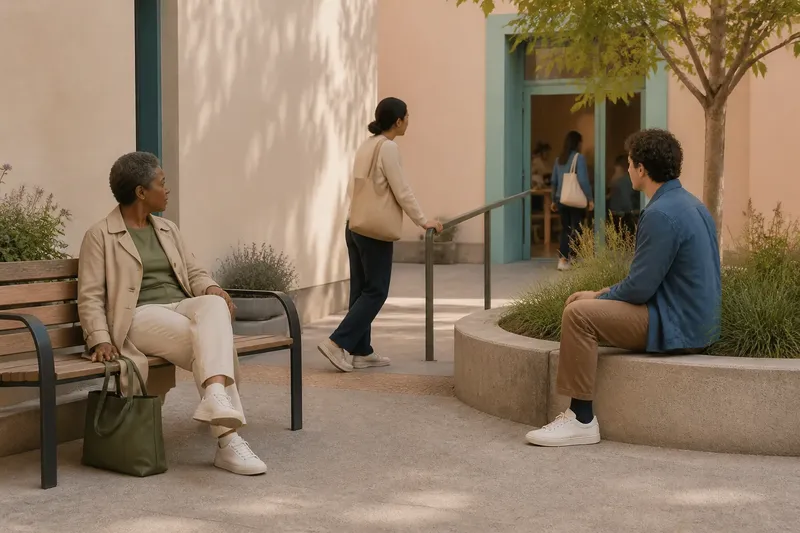
At a bus stop, one person lowers a shopping bag beside them while another leans for a moment and keeps watching the road. A third sits on the low wall around a planter. A bench, leaning rail and open edge each make these pauses possible, but they distribute comfort, space and choice differently. For anyone deciding how people should pause in a shared space, the useful question is not which object looks best; it is who can use it, and what happens around them.
What kind of pause should the space support?
Begin with the likely visit, not the furniture catalogue. A place where people wait for a community meal may need a proper seat and room to set down a bag. A broad pedestrian route may need only a brief resting point that does not encourage a crowd to settle across the path. Notice who already stops, where they stop and what they carry.
Watch the space through ordinary changes in use: a quiet spell, a busy arrival, someone pushing a buggy, a person arriving with a walking stick. These observations do not require recording individuals. They help reveal whether a proposed pause point should support a longer rest, a quick lean or an informal stop without adding furniture.
Also check what people face while pausing. A seat turned towards a lively entrance may suit people-watching but feel exposed to someone waiting for a private conversation. A rail beside a queue may be handy for a short wait, yet awkward if it puts leaning bodies directly in the route of people passing through.
When does a fixed bench make sense?
A bench clearly says, “You can sit here.” That invitation matters where a short stop could turn into a longer rest: beside a play area, outside a shared hall or along a route with few other places to sit. A backrest and armrests can make sitting down and getting up easier for some people. They also make the bench less adaptable to a group that wants to sit side by side in a different arrangement.
Consider the full footprint, including the space people need to approach and leave. A bench set flush against a wall may leave little room for someone who needs to turn, transfer or park a mobility aid nearby. A clear adjacent space can make the seat more usable without requiring the person to ask others to move.
Fixed benches also hold their position, which can help keep seating out of a doorway or route. But that permanence deserves care: a bench can block a useful view, make a narrow route feel tighter or turn a quiet corner into a gathering point. Decide where bags, prams and companions are likely to go, not just where the bench itself fits.
What does a leaning rail offer?
A leaning rail supports a brief pause without asking people to sit. It can suit a place where people want to watch an activity, check a timetable or wait without committing to a seat. Its smaller visual presence may also preserve a more open feeling than a row of benches.
That lightness has limits. A rail generally offers less support than a seat with a back and armrests, and it will not suit everyone who needs to rest. Check its height and shape against the people likely to use it; a narrow horizontal bar can feel less secure than a broad, comfortably shaped surface. Do not treat leaning as a substitute for accessible seating.
Placement changes the experience. Put a rail where a person can pause without leaning into a doorway, a tactile route or the space needed to pass. If it faces a view, allow enough room behind users for other people to move through. A useful rail supports a pause; it should not turn the route into a standing queue.
Can an open edge work without adding furniture?
A low wall, broad planter rim or suitable step edge can already provide an informal place to perch. Keeping an existing edge in use may preserve a clear floor area and avoid adding another object to maintain. It can also let people choose their own position rather than lining up along a formal seat.
But an edge is an ambiguous invitation. Its height, depth, surface and surroundings determine whether sitting feels comfortable and safe. A sharp coping, sloping cap, wet surface or planting that catches clothing can make a promising perch unpleasant. An edge beside a drop or vehicle route can carry risks that a conventional seat avoids.
Ask what the edge is for before treating it as seating. If it is a retaining wall or part of a planted feature, its shape may not be suitable for sitting. Keep the intended function visible, and do not invite people to perch where doing so could damage planting or obstruct access to a facility.
Which pause point fits your space?
Compare the options against actual use rather than appearance alone:
- Longer rests: favour a bench with supportive features and room beside it for mobility aids or bags.
- Brief waits: consider a leaning rail where people can stop without narrowing a route.
- Informal perching: use an open edge only when its surface and position are suitable for sitting.
- Mixed needs: avoid relying on one kind of pause point; a combination can offer different choices.
- Busy circulation: check how each option affects entrances, queues, turning space and through-routes.
Say you are arranging a small courtyard outside a shared kitchen. People arrive with bags, some stay to talk and others only wait for a door to open. A bench with clear space at one end could support a longer rest, while a nearby open edge might suit a brief perch; placing either across the entrance would make both less useful. The decision follows from the observed mix of pauses, not from assuming everyone wants the same seat.
What do people ask about shared-space seating?
Is a leaning rail accessible to everyone?
No. It can support some short stops, but it does not replace seating for people who cannot stand or lean comfortably. Pair it with a suitable seat when the space is intended for a broad mix of visitors.
Should an open edge be treated as a seat?
Only if its surface, location and purpose make perching appropriate. Check for sharp or sloping surfaces, nearby hazards and conflicts with planting or access before encouraging people to use it that way.
How can a bench leave room for a mobility aid?
Provide a clear space alongside the bench rather than expecting an aid to fit in front of seated users. Keep the approach and route past it open, so someone can join a companion without blocking others.
Can these options be mixed?
Yes, if each serves a distinct need and the combination does not crowd the shared route. A bench, rail and perch placed close together without enough circulation space may create one congested stopping area instead of useful choice.
What is not worth the effort?
Do not add decorative rails or odd-shaped edges simply to make a space look less furnished. If a feature has no clear place in the pattern of arrival, waiting and passing, it may become an obstacle or an uncomfortable seat. For a practical choice, return to the main question behind bench, leaning rail or open edge: what kind of pause should this shared space make possible, and for whom?